
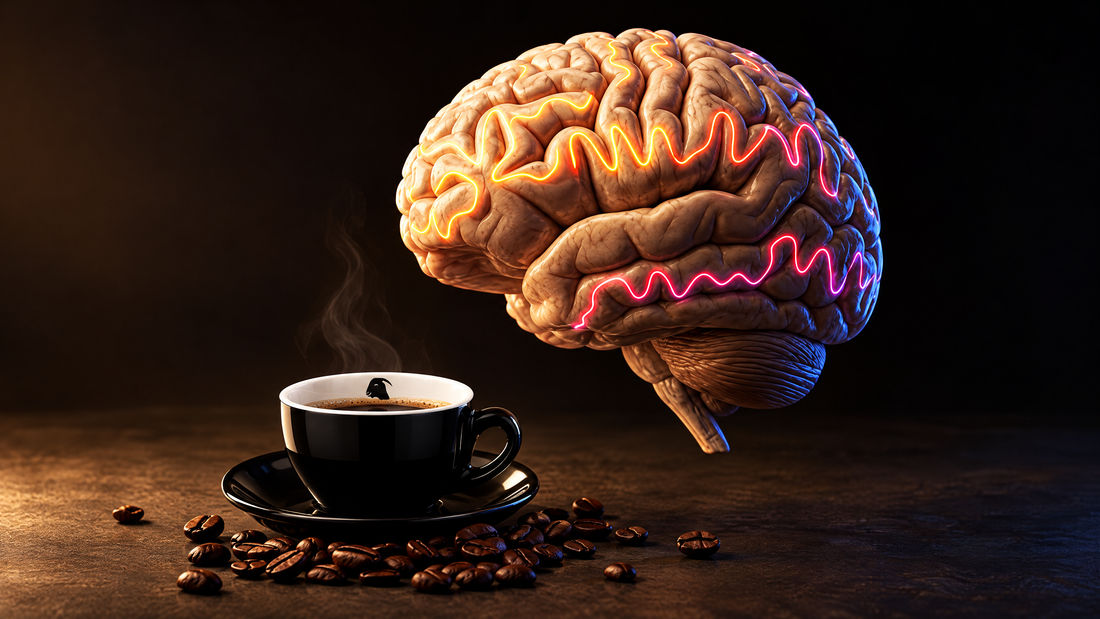
Coffee and Deep Sleep: What Your Brain Waves Reveal
"I can drink an espresso after dinner and sleep like a baby." Most of us know someone who says this, and plenty of us say it ourselves. A new scientific review suggests it might only be half true. You may fall asleep easily and stay asleep all night, yet your brain may still be getting less of the deep, restorative sleep it needs.
What the researchers found
The review, by James Chmiel and Donata Kurpas of Wroclaw Medical University in Poland, was published in the journal Nutrients and highlighted by the university on 22 September. Rather than asking people how they slept, it looked at electroencephalography (EEG) studies, recordings of the brain's electrical activity during the night.
The key finding: caffeine tends to reduce slow-wave activity. These are the large, slow brain waves that dominate deep sleep, the phase most closely linked to physical recovery, memory and feeling genuinely rested. In some cases, the reduction showed up even when total sleep time and the sequence of sleep stages looked normal. The authors describe the effect as shifting the sleeping brain towards a slightly more "wakeful" pattern.
In other words, sleep can look fine on paper and still be lighter than it should be.
Why the timing of your last cup matters
This fits with earlier research. A 2023 meta-analysis in Sleep Medicine Reviews, which pooled 24 studies, found that caffeine reduced total sleep time by around 45 minutes on average and cut the amount of deep sleep. Based on its model, the authors suggested that a standard cup of coffee should be drunk at least 8.8 hours before bedtime to avoid shortening sleep. If you go to bed at 22:30, that means your last coffee around lunchtime.
The European Food Safety Authority (EFSA) takes a similar view. Up to 400 mg of caffeine a day, roughly three to four cups of filter coffee, is considered safe for healthy adults, but even around 100 mg close to bedtime can affect sleep in some people.
Why your colleague really can sleep after espresso (sort of)
The new review also stresses how much people differ. The speed at which your liver breaks down caffeine depends partly on your genes, but also on age, pregnancy, some medications and whether you smoke. For some people, caffeine from a morning coffee has largely cleared by evening. For others, a cup at 15:00 is still active at midnight.
That's why "I sleep fine" isn't a reliable test. Deep-sleep changes are invisible from the inside. You might just wake up a little less refreshed than you could, and put it down to stress or a busy week.
How to enjoy coffee and sleep well
- Front-load your coffee. Enjoy your best cups in the morning and around midday, when caffeine also helps most with alertness.
- Set a personal cut-off. Start with a last cup around early afternoon and move it earlier if you notice lighter or restless sleep.
- Switch format in the afternoon. A smaller cup, a single espresso instead of a double, or a good decaf can keep the ritual without the late caffeine.
- Watch the hidden sources. Tea, cola, energy drinks and chocolate count too.
- Listen to your mornings. If you wake up unrefreshed despite enough hours in bed, try moving your last coffee earlier for two weeks and see what changes.
None of this is a reason to drink less coffee overall. For most healthy adults, moderate coffee drinking is compatible with a healthy lifestyle. It's simply a reason to drink it smarter.
A ritual for the daytime
In Ethiopia, where coffee comes from, it has always been a daytime ritual. The traditional coffee ceremony, with beans roasted in a pan, ground by hand and brewed in a clay jebena, is a moment to gather with family, neighbours and friends during the day, not something rushed late at night.
At Desta's Coffee, our beans come from the Kaffa forest in south-west Ethiopia, where Arabica still grows under the canopy of native trees. We think a coffee grown that slowly deserves to be enjoyed with the same attention: in the morning light, with time to taste it. Grown, not manufactured, and best savoured while the sun is up.
This article is for general information and does not replace medical advice.
Sources
- ScienceDaily / Wroclaw Medical University: Coffee doesn't have to keep you awake to disrupt your sleep (22 September 2026)
- Chmiel J, Kurpas D. The Caffeinated Brain Part 2: The Effect of Caffeine on Sleep-Related EEG. Nutrients 2026;18(8):1220
- Gardiner C et al. The effect of caffeine on subsequent sleep: a systematic review and meta-analysis. Sleep Medicine Reviews 2023;69
- EFSA: Caffeine, scientific opinion on safety