
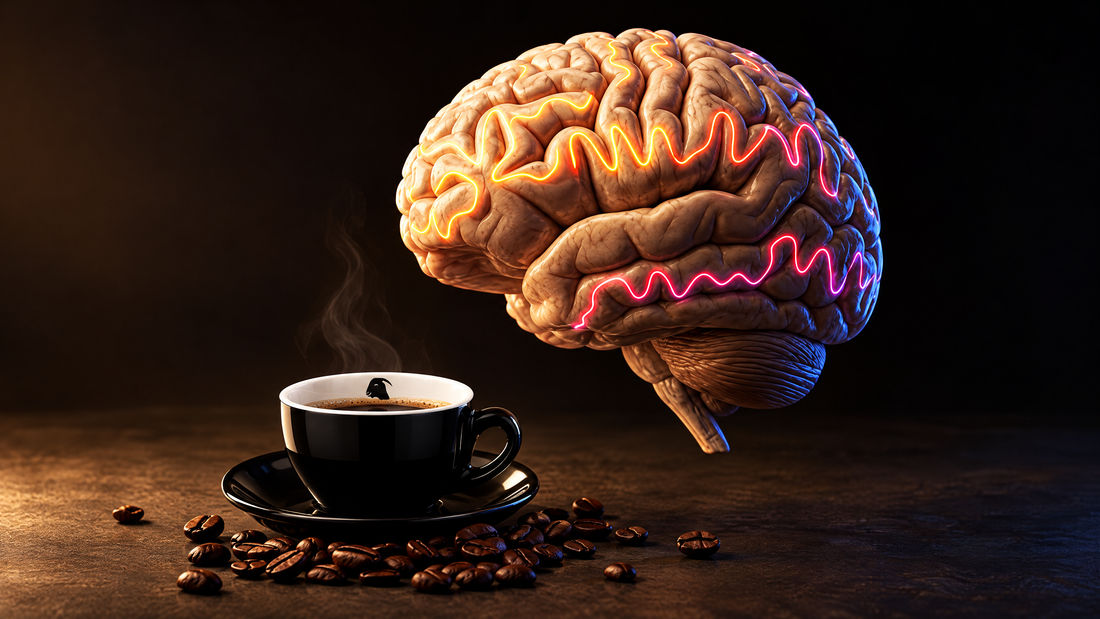
Kaffee und Tiefschlaf: Was deine Hirnwellen verraten
«Ich kann nach dem Znacht noch einen Espresso trinken und schlafe trotzdem wie ein Murmeltier.» Den Satz kennst du bestimmt, vielleicht sagst du ihn sogar selbst. Eine neue wissenschaftliche Übersichtsarbeit legt nahe, dass er nur die halbe Wahrheit ist. Du schläfst vielleicht problemlos ein und die ganze Nacht durch, und trotzdem bekommt dein Gehirn weniger vom tiefen, erholsamen Schlaf, den es braucht.
What the researchers discovered
The work by James Chmiel and Donata Kurpas from the Medical University of Wrocław was published in the journal Nutrients and presented by the university on September 22nd. Instead of asking people about their sleep, the authors analyzed EEG studies, i.e., measurements of electrical brain activity during the night.
The key finding: Caffeine tends to reduce so-called slow-wave activity. These are the large, slow brain waves that characterize deep sleep, the phase most strongly associated with physical recovery, memory, and the feeling of being truly rested. In some cases, the effect was even observed when sleep duration and the sequence of sleep phases appeared normal. The sleeping brain essentially shifts into a slightly more "awake" mode.
In other words: Sleep may look good on paper and still be shallower than it should be.
Why the timing of the last cup matters
This aligns with previous findings. A 2023 meta-analysis in Sleep Medicine Reviews , which summarized 24 studies, concluded that caffeine shortens sleep duration by an average of about 45 minutes and reduces the amount of deep sleep. According to their model, a normal cup of coffee should be consumed at least 8.8 hours before bedtime. So, someone who goes to bed at 10:30 p.m. would drink their last cup of coffee around lunchtime.
The European Food Safety Authority (EFSA) takes a similar view: Up to 400 mg of caffeine per day, roughly equivalent to three to four cups of filter coffee, is considered safe for healthy adults. However, even around 100 mg shortly before bedtime can disrupt sleep in some people.
Why some people actually fall asleep (somehow) after an espresso
The new review also highlights how differently people react. How quickly the liver breaks down caffeine depends partly on genetics, but also on age, pregnancy, certain medications, and smoking. In some people, the caffeine from their morning coffee is largely metabolized by evening, while in others, the 3 p.m. cup still has an effect at midnight.
That's why "I sleep well" isn't a reliable test. You don't directly notice changes in deep sleep. You might simply wake up feeling less refreshed and attribute it to stress or a demanding week. If you want to know more precisely, you can keep a record for a few weeks of when you last drank a cup of coffee and how refreshed you feel the next morning. Often, a pattern emerges after a short time.
This way you can enjoy coffee and still sleep well.
- Drink your coffee early in the morning. Enjoy the best cups in the morning and at lunchtime, as caffeine is most effective against fatigue then.
- Set a personal limit for yourself. Start with your last cup in the early afternoon and move it forward if you sleep more lightly or restlessly.
- Change the format in the afternoon. A smaller cup, a single instead of a double espresso, or a good decaffeinated coffee preserves the ritual without late-night caffeine.
- Think about hidden sources. Black tea, cola, energy drinks, and chocolate also count.
- Listen to your mornings. If you wake up feeling unrested despite spending enough hours in bed, postpone your last coffee for two weeks and observe what changes.
None of this is a reason to drink less coffee altogether. For most healthy adults, moderate coffee consumption fits well into a healthy lifestyle. It's simply a reason to enjoy it more wisely.
A ritual for the day
In Ethiopia, the birthplace of coffee, it has always been a daily ritual. During the traditional coffee ceremony, the beans are roasted in a pan, ground by hand, and brewed in a clay jebena . It is a moment of togetherness with family, neighbors, and friends, during the day and never rushed late at night.
At Desta's Coffee, our beans come from the Kaffa Forest in southwestern Ethiopia, where Arabica still grows today beneath the canopy of native trees. A coffee that grows so slowly deserves to be enjoyed with the same attention: in the morning light, with time to savor its flavors. Grown, not manufactured, and at its best while the sun shines.
This article is for general information purposes only and does not replace medical advice.
Sources
- ScienceDaily / Medical University of Wroclaw: Coffee doesn't have to keep you awake to disrupt your sleep (September 22, 2026)
- Chmiel J, Kurpas D. The Caffeinated Brain Part 2: The Effect of Caffeine on Sleep-Related EEG. Nutrients 2026;18(8):1220
- Gardiner C et al. The effect of caffeine on subsequent sleep: a systematic review and meta-analysis. Sleep Medicine Reviews 2023;69
- EFSA: Koffein, wissenschaftliches Gutachten zur Sicherheit